When to Worry About Milestones (and When Not To)
What the updated CDC milestones say about months 7-12, when missing one is normal variation, and the real red flags worth a doctor call.
6 min read
It's 11 PM, your friend's baby is already cruising, and yours hasn't pulled to stand once. The CDC overhauled its developmental milestone checklists in 2022 and moved most of the revised items to OLDER ages, not younger ones (Zubler et al., Pediatrics, 2022). Here's what the updated milestones actually say for months 7 through 12, when missing one is normal variation, and when it's time to call your pediatrician.
Key takeaways
- The CDC moved 67.7% of relocated milestones to OLDER ages in 2022, so 'behind' by old standards is often 'on track' by new ones.
- Milestones now reflect what 75% of babies can do at a given age, not 50%.
- Bring a written list of what your baby IS and IS NOT doing to the 9-month well-child visit.
- A 12-month-old who isn't babbling, gesturing, or responding to their name needs an evaluation, not a wait-and-see.
- About two-thirds of infants in IDEA Part C early intervention substantially improve their skills.
What CDC actually expects by 9 months
The CDC overhauled its milestone checklists in 2022 for the first time in two decades, with reductions and replacements across the board (Zubler et al., Pediatrics, 2022). Milestones now reflect what 75% of babies can do at a given age, up from 50%.
Translation: if your baby isn't doing something on the list, they're not part of the average half who haven't gotten there yet. They're in a smaller group worth a closer look.
By 9 months, most babies:
- Sit without support and get to a sitting position on their own
- Move things from one hand to their other hand
- Look when you call their name
- Babble strings like 'mamamama' or 'bababababa'
- Look for things you've dropped or hidden
- Bang two things together
Source: CDC Act Early.
Most milestones got later, not earlier
Here's the part that surprises most parents. The 2022 revision moved 67.7% of relocated milestones to older ages, and trimmed the total checklist by 26.4% (Zubler et al., 2022).
The message from the experts who wrote the new list: stop using outdated milestones to panic.
The most quoted example is 'first words.' Used to be a 12-month milestone. It's now expected by 15 months.
So a baby still mostly babbling at their first birthday isn't late. They're squarely in the typical window.
Comparisons are the thief of sanity
Nobody tells you this part. The biggest source of milestone anxiety isn't the CDC list. It's your group chat.
Your sister's kid stood at 8 months. The neighbor's baby is already saying 'dog.' You start watching your own baby with a stopwatch, which is no way to live.
Babies don't develop in lockstep, and skipping a stage is not a problem. A baby who never crawls and goes straight from sitting to cruising at the couch is not behind. They took a different route. Identical twins raised in the same home can hit the same milestone six weeks apart.
The CDC list isn't a race. It's a screen. The point is to catch the small group of kids who genuinely benefit from earlier evaluation, not to rank everyone else.
What the 9-month visit actually covers
The American Academy of Pediatrics recommends a standardized developmental screening at the 9-, 18-, and 30-month well-child visits, not just casual conversation but a real questionnaire (Lipkin & Macias, Pediatrics, 2020). The 9-month appointment is where developmental surveillance turns into formal screening.
Walk in with a list. Either use the CDC's free Milestone Tracker app or open your notes app the night before and write:
- Things your baby IS doing from the 9-month list
- Things your baby IS NOT doing
- Anything that has you worried, even vaguely
- Any skill your baby seemed to have and lost
The 'lost a skill' question matters. If your 10-month-old used to wave bye-bye and stopped, say so. Regression is one of the few signs that earns urgent attention.
When to call sooner: real red flags by 12 months
These aren't 'let's see in three months' symptoms. By 12 months, talk to your pediatrician right away if your baby:
- Doesn't babble at all (no 'mama,' 'baba,' consonant sounds)
- Doesn't use any gestures (no waving, no pointing, no pat-a-cake)
- Doesn't respond to their name when you call
- Has lost a skill they once had
- Isn't pulling to stand or bearing weight on legs
- Doesn't make eye contact or share smiles
Do not wait. Ask for a developmental evaluation and a referral to your state's IDEA Part C early intervention program. Part C services are free or reduced cost under federal law for any infant or toddler who qualifies, and you don't need a diagnosis to be evaluated (CDC Act Early, IDEA Part C).
What 'early' in early intervention actually means
Early intervention isn't a last resort. About two-thirds of infants in IDEA Part C substantially improve their skills, and roughly half catch up to age-level expectations (ECTA Center, IDEA Part C national outcomes). You can self-refer in every state, no doctor's note needed.
So if something feels off, you don't have to be sure. You just have to mention it. The earlier you raise it, the faster the right help shows up.
Your job isn't to diagnose. It's to notice. And you already are.
For dads
Here's your move:
Pull up the CDC 9-month or 12-month milestone page on your phone tonight and write two short lists: what your baby IS doing, and what your baby IS NOT doing. Bring both to the next pediatrician visit. Don't outsource this to your partner. You watch your baby differently than she does, and babies often demonstrate skills with one parent that another never sees. If something on the 'not doing' list feels off, say the word 'concerned' out loud at the appointment. That single word triggers a different kind of conversation.
Real talk:
You will Google. You will compare. You will see a coworker's baby on Instagram already standing at the couch and feel a flash of cold worry about your own kid. That feeling is your love showing up sideways. Most of the time the worry is misfiring. Your baby is on a totally normal path, just on their own schedule. But the same attention that lets you spot trouble at 2 AM is the attention that catches real delays early. Calibrate, don't catastrophize. Watching closely is the job. Drawing conclusions from a single data point isn't.
Product picks
As an Amazon Associate, Cradlebug earns from qualifying purchases — at no extra cost to you. Learn more

VTech Sit-to-Stand Learning Walker
The push walker most parents end up with. Supports the 12-month CDC milestone of walking while holding on, with detachable activity panel for floor play.
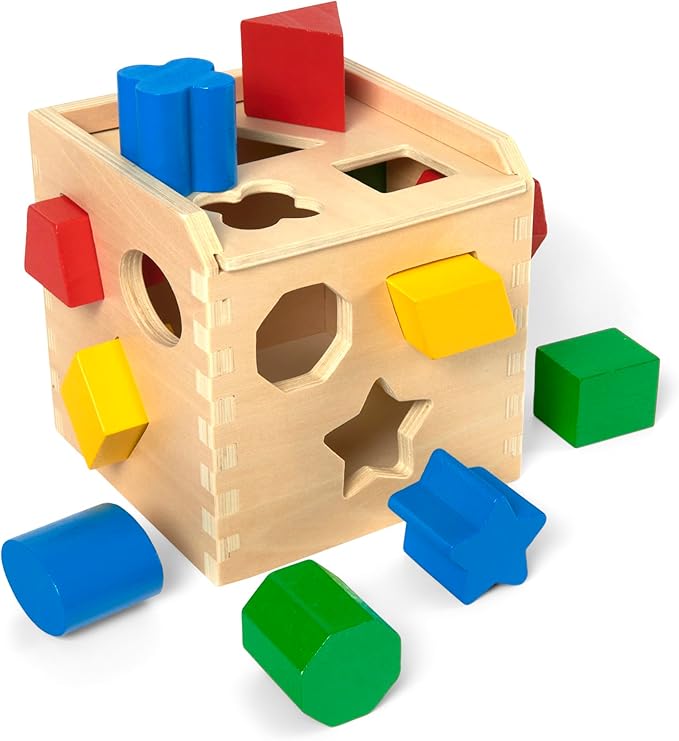
Melissa & Doug Shape Sorting Cube
Wooden classic that grows with your baby from 9 months onward. Supports the cause-and-effect learning the CDC list calls 'puts something in a container.'

Fisher-Price Baby's First Blocks (Set of 10)
The classic shape-into-bucket toy. A direct way to practice the 12-month CDC milestone of putting something in a container.
Common questions
Is my 10-month-old behind because she's not crawling?+
No. Crawling isn't on the CDC milestone list because plenty of babies skip it entirely. As long as she's mobile some way (rolling, scooting, getting to sitting) and using both hands, she's fine.
My 9-month-old isn't saying 'mama' or 'dada' yet. Should I worry?+
Probably not. The 9-month milestone is babbling sounds like 'mamamama' and 'bababababa,' not real words. Calling a parent 'mama' or 'dada' with meaning is the 12-month milestone.
My baby is 12 months and not walking. Is that a problem?+
Probably not. The CDC's 12-month milestone is walking while holding on to furniture, not walking on her own. Most babies take their first solo steps between 12 and 15 months, and the typical range stretches to about 17 months.
What if my pediatrician says 'let's wait and see'?+
You can ask for a standardized developmental screening anyway. The AAP recommends one at the 9-month visit, and you can also self-refer to your state's IDEA Part C early intervention program without a doctor's note.
Does early intervention actually work?+
Yes. National outcomes data on IDEA Part C show about two-thirds of infants in early intervention substantially improve their skills, and roughly half catch up to age-level expectations.
We had a preemie. Should I use adjusted age?+
For development, most pediatricians use corrected age until about 2 years old. A baby born at 35 weeks who is 9 months old by birthday is about 8 months developmentally, so check her against the 6-month list and ask your pediatrician about formal screening adjustments.
Related articles
Starting Solids: A Month-by-Month Guide
When to start solids, what to serve first, and the allergen research that changed everything.
Health & SafetyBaby-Proofing Your Home Room by Room
A room-by-room baby-proofing guide with the stuff that actually prevents injuries.
Activities & PlayScreen-Free Play Ideas for 6-12 Month Olds
Play ideas that support development, cost almost nothing, and don't require a single app.
Sources
- CDC, Milestones by 9 Months (updated Feb 2026) — https://www.cdc.gov/act-early/milestones/9-months.html
- CDC, Milestones by 1 Year (updated Feb 2026) — https://www.cdc.gov/act-early/milestones/1-year.html
- Zubler JM, et al., Evidence-Informed Milestones for Developmental Surveillance Tools, Pediatrics 149(3): e2021052138 (2022) — https://pubmed.ncbi.nlm.nih.gov/35132439/
- Lipkin PH, Macias MM, Promoting Optimal Development: Identifying Infants and Young Children With Developmental Disorders Through Developmental Surveillance and Screening, Pediatrics 145(1): e20193449 (2020) — https://pubmed.ncbi.nlm.nih.gov/31843861/
- ECTA Center, IDEA Part C National Program Data — https://ectacenter.org/partc/partcdata.asp
A quick note: This content is for informational purposes only and is not a substitute for professional medical advice. Always talk to your healthcare provider about any questions or concerns. Content based on guidance from the American Academy of Pediatrics (AAP), the World Health Organization (WHO), the Centers for Disease Control and Prevention (CDC), Mayo Clinic, and peer-reviewed medical literature. Learn how we create our content.